1975—1988
The Dark HalfThe period from 1975 to 1988 traces George Stark from a separate name on a manuscript to a celebrated crime-fiction brand, then to an identity Thad Beaumont chose to expose and symbolically bury. Its significance lies in the double movement: Beaumont uses a pseudonym to escape a creative impasse, but the persona’s fictional independence becomes increasingly difficult to contain, until ending the public charade takes the form of a staged funeral and a real confrontation with violence.
The Name and Its Literary Model
Beaumont dates the beginning to a night in 1975, when he settled on the name George Stark. He needed more than a convenient alias: he believed the right identity, one distinct from his own, could break his writer’s block. The name drew on a literary precedent. Beaumont admired the contrast between Donald E. Westlake’s comic social novels under his own name and the stark crime novels Westlake published as Richard Stark, featuring Parker, a professional thief with few interests beyond robbery.
The model offered Beaumont both a practical separation and a tonal permission. He recalled Westlake’s account of writing under his own name on sunny days and letting Stark take over on rainy ones; for Beaumont, the years between 1973 and early 1975 had felt like such a rainy stretch. Parker’s nearly mechanical pursuit of money also supplied a recognizable pattern for George Stark’s fictional world. Beaumont later connected that pattern to Alexis Machine, the central character of the first and last George Stark novels, whose single-mindedness makes the borrowed crime-fiction machinery visible even as the work finds a voice of its own.
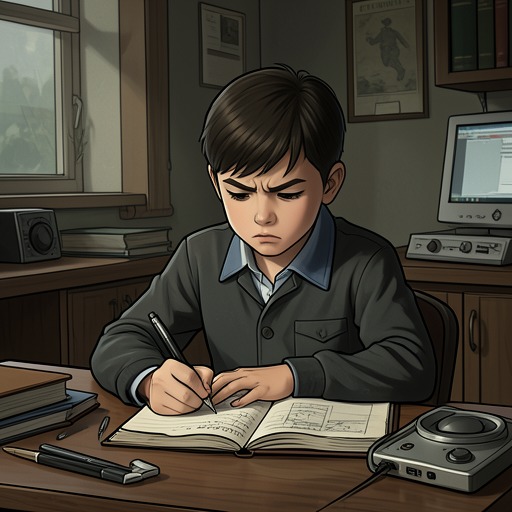
The first writing session made the separation tangible. Beaumont rolled a sheet of paper into his typewriter, then took it back out: he had typed all his books, but George Stark, he said, apparently did not accept typewriters. The detail turns a choice of name into a difference in method and imagined character. Beaumont began Machine’s Way by hand, as if the new identity had arrived with preferences of its own.
Publication and the Hidden Author
Machine’s Way was published in June 1976 by Darwin Press, a smaller publisher than the one issuing Beaumont’s work under his own name. The novel became a surprise bestseller, reached number one on lists across the country, and was made into a successful film. Its copyright named George Stark, and the separation held not because the author was entirely unknown to the people around the book, but because those who knew kept the secret.
Beaumont said his agent, the agent’s former wife and business partner, senior Darwin Press executives, and the company comptroller knew the truth. The practical complication was difficult to disguise indefinitely: George could write novels in longhand but could not endorse the checks. The tax authorities also had to know. Nevertheless, Beaumont and Liz waited roughly a year and a half for someone to expose him, and no one did. The concealment then continued for another decade.
During those years, Stark published three more novels and proved more prolific than Beaumont’s other literary identity. None matched Machine’s Way’s exceptional success, but all made their way up bestseller lists. The novels also acquired readers who knew them simply as George Stark books. Dodie Eberhart, a landlord with a strong attachment to crime fiction, regarded Stark as the best of the writers she read and followed his work from Machine’s Way through Oxford Blues to Riding to Babylon. Her enthusiasm shows how thoroughly the pseudonym had become a public author in his own right: the readership could admire the name without knowing the person behind it.
Genre, Persona, and the World Outside the Books
The Stark books drew on a crime-fiction tradition of professional criminals, direct action, and a ruthless concentration on money. Beaumont’s explanation of Parker’s repetitive demand, “I want my money,” identifies the hard, narrowly programmed quality he admired in the model. That tradition did more than shape a publishing identity: in the novel’s present-day plot, Stark’s fictional manner and criminal world become a framework through which real events can be read—and, more disturbingly, enacted.
The contrast between genre and reality sharpens in Beaumont’s conversation with Sheriff Alan Pangborn. Beaumont sketches the elaborate twin-based explanation that might account for his presence in Castle Rock during Homer Gamache’s murder and elsewhere during the crimes, turning the police theory into a grimly comic plot. His invented scenario demonstrates how readily the facts can be arranged to resemble a crime novel, while its impossibility exposes the gap between the neat mechanisms of fiction and the actual case.
That boundary is also crossed by Stark himself. In New York, he waits in the hallway outside Michael Donaldson’s apartment and attacks him with a straight razor. The attempt does not go as Stark intended: Donaldson reacts quickly enough to evade the most direct part of the assault. The scene brings the violence associated with Stark’s crime-fiction lineage into the material world of the novel, where genre formulas no longer remain safely on the page.
Ending the Charade
By the time Beaumont decided to go public, the arrangement had become both materially useful and creatively restrictive. Stark’s books earned money that Beaumont called his “f— you money,” giving him the freedom to imagine leaving teaching while continuing to pay the mortgage. Yet he wanted to write his own books again, and he believed Stark was running out of things to say. Liz, his agent, and even Stark’s editor at Darwin Press, he said, recognized the decline. Keeping the secret would also leave open the temptation to produce another profitable book under the pseudonym.
Beaumont therefore described exposure as a way to end the arrangement once and for all. The public revelation appears not simply as a confession but as a deliberate closing act: he would drive a stake through the profitable fiction by naming himself as its author. That language of ending acquires a visible counterpart in the People magazine profile. Its small photograph shows Beaumont and Liz in a graveyard, carrying cemetery tools beside a flower-covered grave. The readable stone names George Stark, gives the dates 1975–1988, and labels him “Not a Very Nice Guy.” The two figures pose as cheerful gravediggers over the fictional author’s grave.
The burial image is staged, as are the other photographs accompanying the article. Beaumont recognizes that the scene has been arranged to fit the magazine’s appetite for celebrity and spectacle, just as he has arranged a public story around his pseudonym. The years thus close on a deliberately constructed ending: George Stark’s career is made visible and given a grave, even as the novel’s events complicate the claim that a name and its violence can be dispatched by public disclosure alone.